
HMAS Air Master was one of 21 air/sea rescue (ASR) vessels originally built in the United States and Canada between 1943 and 1945 and transferred to the Royal Australian Navy under their Lend-Lease Agreement. These vessels were originally designed as anti-submarine craft, but their high speed and manoeuvrability made them ideal as search and rescue vessels. In this role, their hulls were painted black and their upper decks and superstructure painted bright yellow. One vessel, HMAS Air Sprite, was built locally in 1960 to an almost identical design.

Air Master was commissioned on 31 August 1944 in Sydney under the command of Skipper (later Sub Lieutenant RANVR) Norman Shield and officially listed as a tender to HMAS Rushcutter, and later to HMAS Madang. It remained alongside in Sydney preparing for sea until 10 January 1945 when it and HMAS Air Watch were towed to Glebe Island and the following day lifted aboard the American liberty ship, SS Andrew T Huntington, for transport to New Guinea. Once lifted out of the water, the hulls of both boats were found to be in a filthy state with no slip having been available to clean them prior to transport. The 2 ships’ companies busied themselves with cleaning the boats’ hulls en route northwards.
Andrew T Huntington arrived at Langemak, New Guinea, on 20 January and the 2 boats were unloaded. Air Watch by the ship’s gear and Air Master by a floating crane. Both boats also suffered damage during the unloading. Air Watch lost a radar antenna while Air Master’s mast was smashed on the boom block of the ship’s gear. Repairs were undertaken at Langemak and both boats conducted engine trials between 24 and 30 January. The pair departed Langemak for Madang on 4 February.
Air Master conducted ASR duties at Madang through to May and occasionally provided medical transport and delivered stores to nearby Allied bases and outposts. It moved to Aitape for ASR duties on 10 May and then on to Morotai, Indonesia, under tow from MV Comara in tandem with HMAS Air Mist, later in the month.
A defect in the port engine delayed its voyage to Aitape and once there, on 15 May, it struck an underwater object damaging the blades on its port propeller. Practice shoots often revealed problems with its Lewis guns, and it had been experiencing problems with its wireless radio equipment since arriving in New Guinea.
It arrived at Morotai on 3 June and commenced ASR duties but at the end of the month was once again reallocated to Balikpapan. It departed Morotai on 28 June under tow from HMAS Cootamundra, in tandem with HMAS Air Mist, and arrived at Balikpapan on 3 July. It was employed primarily as a medical transport until 15 July when it recommenced normal ASR duties. Its bad luck continued when it struck a submerged cable on 9 July damaging its port rudder. It was replaced that evening.
Air Master’s return to Australia began on 22 November being taken in tow that afternoon by HMAS Inverell in tandem with HMAS Air Mist. They arrived in Brisbane on 14 December where HMAS Geraldton took up the tow. On 18 December Air Mist’s tow parted, and it drifted away in a northerly direction. Attempts to resume the tow were unsuccessful and Air Mist was abandoned as it drifted dangerously close to rocks off Morna Point, Air Master taking off its crew. Air Master continued under its own power from Newcastle, escorted by HMAS Junee, and arrived in Sydney on 23 December.
After undergoing a refit, it proceeded northwards to Darwin under tow of HMAS Condamine and later HMAS Barwon in tandem with HMAS Air Clan. The voyage proved a difficult one as the tow parted several times in heavy weather and the 2 ASRs also collided several times. However, Air Master, Air Clan and Barwon all arrived safely in Darwin on 17 April 1946. On 20 May Air Master proceeded to West Point Beach to recover the body of a deceased sailor who had drowned after his dinghy had capsized.
On 18 August it embarked the Governor-General, His Royal Highness Prince Henry, the Duke of Gloucester and his royal party for a circuit of Darwin Harbour with HMAS Air Cloud in company. Three days later it undertook a medical transport for a civilian from Cape Don Darwin.
On 5 September, Air Master and Air Cloud conducted a search and rescue operation for the survivors of a RAAF Douglas C47 aircraft which had crashed off East Point during a test flight. Air Cloud rescued 2 survivors while a civil aviation control launch rescued 3 others, later transferring them to Air Master for passage back to Darwin.
Apart from these occasional excursions, however, it was infrequently employed at Darwin, and it returned to Sydney where it decommissioned on 20 February 1947.
It recommissioned on 20 May 1949 as a search and rescue vessel operating between Sydney and Jervis Bay and paid off again into dockyard control on 3 November 1953. It recommissioned yet again on 23 February 1954 and remained listed as a search and rescue vessel until 1963. It was sunk as a target, testing the effectiveness of the Seacat missile against small, fast targets, in 1968.
Specifications
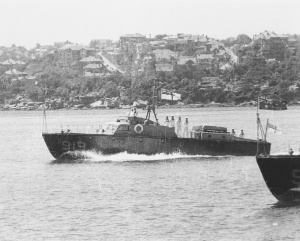 |
| Class |
Air/Sea Search and Rescue Vessel |
|---|---|
| Type |
Air-Sea Rescue Launch |
| Pennant |
ASR919 |
| Builder |
Fellows & Stewart Inc, USA |
| Commissioned |
31 August 1944 |
| Decommissioned |
20 February 1947 |
| Fate |
Sunk as a target, 1968 |
| Dimensions & Displacement | |
| Displacement | 24 tons |
| Length | 63 feet (19.2 metres) |
| Beam | 15 feet (4.57 metres) |
| Draught | 3 feet 4 inches (1.01 metres) |
| Performance | |
| Speed | Up to 28 knots |
| Complement | |
| Crew | 7-8 including 2 RAAF telegraphists |
| Propulsion | |
| Machinery | Twin Hall-Scott petrol engines |
| Horsepower | 1200 bhp |
| Armament | |
| Guns | 2 x twin Lewis guns |