
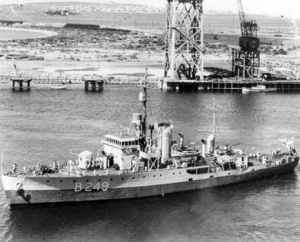
HMAS Pirie at Port Pirie in February 1946

HMAS Pirie was one of 60 Australian Minesweepers (commonly known as corvettes) built during the Second World War in Australian shipyards as part of the Commonwealth Government’s wartime shipbuilding program. Twenty (including Pirie) were built on Admiralty order but crewed and commissioned by the Royal Australian Navy. Thirty-six were built for the Royal Australian Navy and 4 for the Royal Indian Navy.
HMAS Pirie was laid down on 9 May 1941 and was launched by Mrs Kleeman, wife of Whyalla Superintendent, Broken Hill Pty Ltd on 3 December 1941. It commissioned at Whyalla on 10 October 1942 under the command of Lieutenant Commander Charles F Mills RAN (Emergency List).
HMAS Pirie at Port Pirie in February 1946
Pirie completed its working up period in home waters in December 1942 before being assigned to convoy escort duty operating between Queensland, New South Wales and New Guinea.
It was at Milne Bay on 24 March 1943, when 27 enemy aircraft passed overhead en route to attack shore targets. Off Oro Bay (New Guinea) on 11 April 1943, Pirie was escorting the British vessel SS Hanyang as part of Operation LILLIPUT, the reinforcement, supply and development of the Buna-Gona area after its capture. Pirie was subjected to a particularly determined attack by a large force of Japanese fighters and dive bombers. It experienced 6 very close misses and one direct hit which struck the bullet proof canopy over the bridge, penetrated it, glanced off the helmsman’s protective apron, struck and killed instantly the Gunnery Officer and then striking the upper deck, exploded killing 6 sailors and wounding 4 others. Fortunately, after hitting Pirie the enemy broke off the attack having lost several aircraft hit by close range anti-aircraft fire.
Repairs were completed in May 1943 and Pirie resumed operations escorting convoys proceeding between the Australian east coast and New Guinea. At this time Japanese offensive submarine operations in Australian waters were ending after being active for several months. Following Pirie’s return to service only 2 ships were lost in Australian waters because of Japanese submarine attacks. These were the hospital ship Centaur, which was lost with 268 lives on 14 May 1943, and the United States vessel SS Protmar, which was torpedoed and sunk off the New South Wales coast on 16 June 1943.
Pirie was under refit at Garden Island from mid-November to early December 1943.
From April to July 1944 Pirie was mainly engaged in escorting convoys moving along Australia’s northern coast between Thursday Island and Darwin. In August 1944 it was assigned to duty as a minesweeper and assisted by HMAS Kalgoorlie (I) began a series of clearing sweeps of defensive minefields in the Great Barrier Reef area. This task was completed at the end of September 1944 and after a refit at Brisbane Pirie sailed for Fremantle in mid-December. On 24 November 1944 the ship had been designated as a unit of the 22nd Minesweeping Flotilla on its reformation.
On 31 January 1945 Pirie sailed from Fremantle for Sydney and from there on 24 February, sailed for Manus (Admiralty Islands) as a unit of the British Pacific Fleet. From Manus it proceeded to the Philippines and thereafter until hostilities ended, excepting for 3 weeks spent in Brisbane in June, it was almost constantly at sea acting as an escort vessel to units of the Fleet. Pirie also participated in the operation for the capture of Okinawa (March to May 1945).
On 31 August 1945 Pirie entered Tokyo Bay, being the third Australian warship to enter Japanese home waters since hostilities commenced, preceded only by the destroyers HMA Ships Napier and Nizam. In mid-September it proceeded to Hong Kong where it was engaged on local patrol duty until 11 October 1945, when it sailed to return to Australia. It reached Brisbane on 30 October 1945. After service in Australian waters, which included a visit to its namesake town of Port Pirie, the ship arrived at Sydney on 28 February 1946. It had steamed a total of 117 230 miles since commissioning in October 1942.
On 5 April 1946, at Sydney, Pirie paid off and recommissioned in the Royal Navy as HMS Pirie. On 21 May 1946 it sailed for Colombo with Gawler and Launceston. All were destined for transfer to the Turkish Navy.
As a unit of the Turkish Navy Pirie was renamed Amasra. The vessel was not listed in ‘Jane’s Fighting Ships’ after the 1971/72 issue. In 1984, in answer to a query from the HMAS Pirie Association, the Turkish Consulate General advised that ‘Amasra was put out of service on 26 March 1984 after having rendered valuable service to the Turkish Navy’.


 |
| Class |
Bathurst Class |
|---|---|
| Type |
Australian Minesweeper |
| Pennant |
J189 |
| Builder |
Broken Hill Pty Ltd, Whyalla |
| Laid Down |
19 May 1941 |
| Launched |
3 December 1941 |
| Launched by |
Mrs Kleeman, wife of Whyalla Superintendent, Broken Hill Pty Ltd |
| Commissioned |
10 October 1942 |
| Decommissioned |
5 April 1946 |
| Fate |
Transferred to the Turkish Navy in which she served until 1984 |
| Dimensions & Displacement | |
| Displacement | 733 tons |
| Length | 186 feet |
| Beam | 31 feet |
| Draught | 8 feet 6 inches |
| Performance | |
| Speed | 15 knots |
| Complement | |
| Crew | 85 |
| Propulsion | |
| Machinery | Triple expansion, 2 shafts |
| Horsepower | 2,000 |
| Armament | |
| Guns |
|
| Other Armament |
|
| Radars |
|
| Sonars | Type 128 BC ASDIC |
| Awards | |
| Battle Honours |
|